Settlers of Powassan - 1
Transcription
Machine transcription; it may contain errors.
Item: book. Legibility: good.
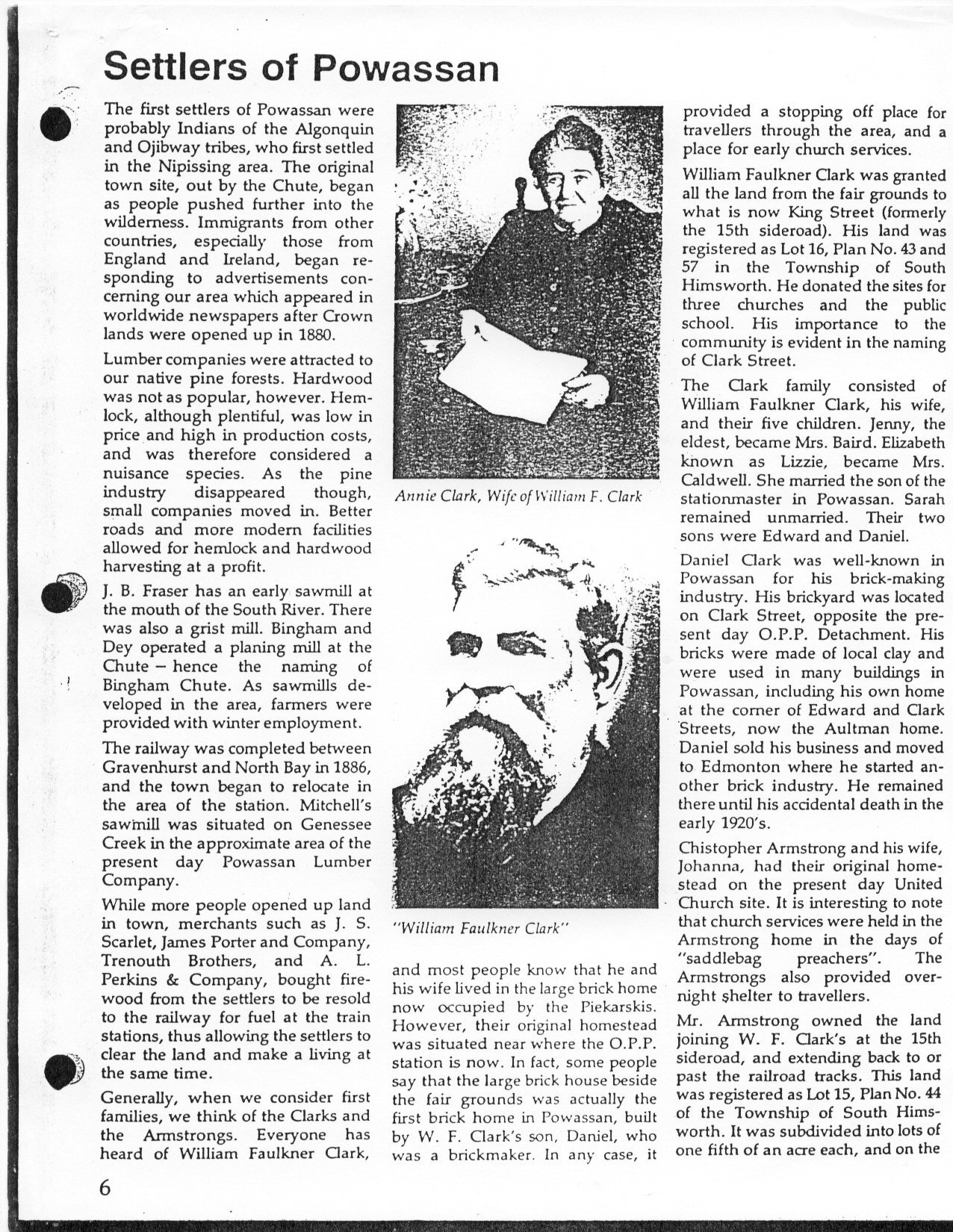
Settlers of Powassan
The first settlers of Powassan were
probably Indians of the Algonquin
and Ojibway tribes, who first settled
in the Nipissing area. The original
town site, out by the Chute, began
as people pushed further into the
wilderness. Immigrants from other
countries, especially those from
England and Ireland, began re-
sponding to advertisements con-
cerning our area which appeared in
worldwide newspapers after Crown
lands were opened up in 1880.
Lumber companies were attracted to
our native pine forests. Hardwood
was not as popular, however. Hem-
lock, although plentiful, was low in
price and high in production costs,
and was therefore considered a
nuisance species. As the pine
industry disappeared though,
small companies moved in. Better
roads and more modern facilities
allowed for hemlock and hardwood
harvesting at a profit.
J. B. Fraser has an early sawmill at
the mouth of the South River. There
was also a grist mill. Bingham and
Dey operated a planing mill at the
Chute - hence the naming of
Bingham Chute. As sawmills de-
veloped in the area, farmers were
provided with winter employment.
The railway was completed between
Gravenhurst and North Bay in 1886,
and the town began to relocate in
the area of the station. Mitchell's
sawmill was situated on Genessee
Creek in the approximate area of the
present day Powassan Lumber
Company.
While more people opened up land
in town, merchants such as J. S.
Scarlet, James Porter and Company,
Trenouth Brothers, and A. L.
Perkins & Company, bought fire-
wood from the settlers to be resold
to the railway for fuel at the train
stations, thus allowing the settlers to
clear the land and make a living at
the same time.
Generally, when we consider first
families, we think of the Clarks and
the Armstrongs. Everyone has
heard of William Faulkner Clark,
Annie Clark, Wife of William F. Clark
"William Faulkner Clark"
and most people know that he and
his wife lived in the large brick home
now occupied by the Piekarskis.
However, their original homestead
was situated near where the O.P.P.
station is now. In fact, some people
say that the large brick house beside
the fair grounds was actually the
first brick home in Powassan, built
by W. F. Clark's son, Daniel, who
was a brickmaker. In any case, it
provided a stopping off place for
travellers through the area, and a
place for early church services.
William Faulkner Clark was gra